
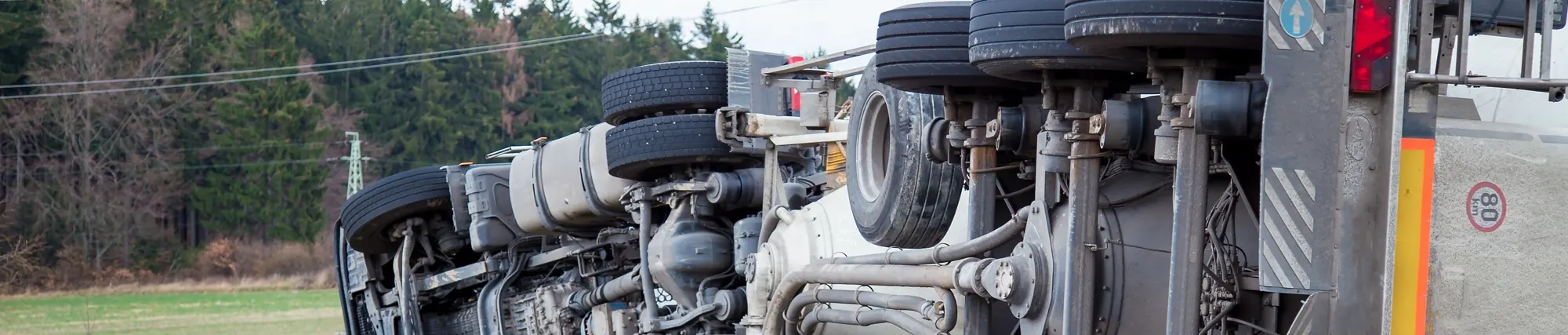

A crash with a semi-truck is not an ordinary car accident. A loaded tractor-trailer can weigh up to 80,000 pounds, often 20 to 30 times as much as the car it hits, and the people in the smaller vehicle take the worst of it. The claim that follows is different too: trucking companies answer to federal safety rules, they keep records most drivers never think about, and their insurers move quickly after a crash.
This guide explains what to do after a truck accident in Oklahoma, what usually causes these crashes, who can be held responsible, which evidence matters and how a claim works. If you have questions about your own case, the truck accident lawyers at Levinson Law, P.C. in Tulsa can help: call 918-492-4433.
In this guide
- What to do after a truck accident
- Mistakes that can hurt your claim
- Why truck crashes are different
- Common causes of truck accidents
- Who can be held liable
- The evidence that matters
- How a truck accident claim works
- What compensation may cover
What to do after a truck accident
If you are able to, these steps protect your health and your claim:
- Get help for anyone who is hurt. Call 911 for an ambulance and move to safety if you can do so without risk.
- Call the police. An officer’s crash report records the scene, the drivers, the vehicles and the officer’s view of what happened, and it lists witnesses you may not find later. Ask how to get a copy; it is usually available within a few days.
- Exchange information. Oklahoma law requires drivers in a crash that causes injury or damage to stop and exchange information. From the truck driver, get their name, address and phone number, driver’s license number, the vehicle’s registration and plate, the insurance details, and the name of the company they drive for. The company name and the USDOT number painted on the cab are often more important than the driver’s own details.
- Collect witness details. Write down the name, phone number and email of anyone who saw the crash. Witnesses are hard to track down after they leave the scene.
- Take photos. Photograph the vehicles and their positions, the damage, skid marks, debris or spilled cargo, the road, traffic signs and your injuries.
- See a doctor right away, even if you feel fine. Some serious injuries, including brain injuries and internal bleeding, show no symptoms for hours or days. Then follow the treatment plan you are given.
- Keep every record. Save medical bills, repair estimates, receipts and notes on missed work.
- Talk to a lawyer before you talk to the trucking company’s insurer. Key evidence, such as the truck’s electronic data, can be lost if no one asks for it to be preserved.
Mistakes that can hurt your claim
Even when the truck driver was clearly at fault, a few common mistakes can lower a settlement or give the insurer a reason to deny it:
- Saying the crash was your fault. Shock and adrenaline affect memory, and it is often impossible to know right away what really caused a crash. A remark to the driver, a witness, an officer or an insurer that you “might have” caused it can be used against you later. Let the investigation answer that question.
- Waiting to get medical care. The longer the gap between the crash and your first treatment, the easier it is for an insurer to argue that your injury came from something else. Skipping follow-up care can be used the same way.
- Exaggerating or downplaying your injuries. Overstating them hurts your credibility; understating them can mean a settlement that doesn’t cover your care. Describe your symptoms honestly to your doctor and to anyone handling the claim.
- Posting on social media. Insurers look. A family photo or a cheerful status update can be taken out of context as proof that you aren’t really hurt. It’s safest not to post about the crash, or at all, while the claim is open.
- Discussing the crash with others. Anything you say about the accident can be repeated. Keep the details between you and your lawyer until the claim is resolved.
- Accepting a quick offer. Early offers often come before the full cost of an injury is known. Once you sign a release, you usually can’t ask for more.
Why truck crashes are different
Size is the obvious difference. A typical semi-truck is about 72 feet long, 8.5 feet wide and 13.5 feet tall. It needs far more distance to stop, makes wide turns, has a high center of gravity that makes rollovers more likely, and has large blind spots: roughly 20 feet in front of the cab, 30 feet behind the trailer, and long stretches along both sides, especially the right. For practical advice on driving near big rigs, see safely sharing the road with semi-trucks in Oklahoma.
The legal difference is that most large trucks are commercial motor vehicles, which brings in federal safety rules from the Federal Motor Carrier Safety Administration (FMCSA). Under federal rules, a vehicle used in interstate commerce generally qualifies if it:
- has a gross vehicle weight or weight rating of 10,001 pounds or more;
- is designed or used to carry more than 8 passengers for compensation, or more than 15 passengers without compensation; or
- carries hazardous materials in amounts that require placards.
That covers far more than tractor-trailers: box trucks, dump trucks, flatbeds, tankers, buses and many work trucks can all qualify. When they do, the driver and the company must follow rules on hours behind the wheel, rest breaks, driver qualification, drug and alcohol testing, inspections, maintenance and cargo securement. A broken rule is often the starting point for proving fault.
Commercial drivers are also held to a stricter alcohol limit. Most drivers in the U.S. are legally impaired at a blood alcohol concentration (BAC) of 0.08 percent; for a commercial driver operating a commercial vehicle, the limit is 0.04 percent.
Common causes of truck accidents
Most truck crashes trace back to a preventable failure by the driver, the trucking company or someone who loaded or maintained the truck. These are the causes we see most often. For the shapes these crashes take, from jackknifes and rollovers to underride and override collisions, see the different types of truck accidents.
Driver fatigue and hours-of-service violations
Truck drivers work long shifts, often overnight or starting before dawn, which disrupts normal sleep. Fatigue slows reaction time, narrows attention and impairs judgment much like alcohol does: according to the CDC, being awake for 17 hours affects a driver about as much as a BAC of 0.05 percent, and 24 hours awake is comparable to 0.10 percent. A drowsy driver may drift between lanes, misjudge speed or following distance, or never brake at all before impact.
To limit fatigue, federal hours-of-service rules for property-carrying drivers generally allow no more than 11 hours of driving after 10 consecutive hours off duty, no driving after the 14th hour on duty, a 30-minute break after 8 cumulative hours of driving, and no driving after 60 hours on duty in 7 days or 70 hours in 8 days. Drivers record this time, usually on an electronic logging device. Tight delivery schedules push some drivers, and some companies, to ignore these limits.
Inexperience and poor training
A shortage of qualified drivers has led many companies to put new drivers behind the wheel quickly. Research for the FMCSA has found that inexperience raises truck drivers’ crash risk across age groups. Inexperienced or poorly trained drivers are more likely to speed, follow too closely, change lanes into a blind spot, take turns too fast in a top-heavy vehicle, skip required rest breaks and pre-trip inspections, and load cargo incorrectly. When a company hires a driver who isn’t qualified, or doesn’t train them, the company can share the blame.
Speeding and unsafe driving
A fully loaded truck takes far longer to stop than a car, so speed that would be merely risky in a car can be deadly in a truck, especially in heavy traffic, on curves, on hills and in work zones. Tailgating, unsafe lane changes, failing to yield and distracted driving, such as using a phone or GPS at the wheel, cause many of the same crashes.
Drugs and alcohol
Because of the 0.04 percent limit, a commercial driver can be impaired under the law at a level that would be legal for other drivers. Trucking companies must also run drug and alcohol testing programs, and a failure to test can be evidence of negligence.
Brake failure and poor maintenance
Commercial trucks cover enormous distances under heavy loads, so their brakes, tires, lights and couplings wear out quickly. Federal rules require trucks to be inspected and maintained, and a truck whose brakes fall below the FMCSA’s minimum braking efficiency is considered unfit to drive. Brake problems are common: in the Commercial Vehicle Safety Alliance’s 2023 nationwide brake-check event, about one in eight inspected vehicles was ordered out of service for brake violations such as worn or cracked linings, broken drums, out-of-adjustment brakes and air-system defects.
Failing brakes can cause a loss of control, a runaway truck, a rollover, a jackknife or a rear-end crash. Worn tires raise the risk of blowouts, and dead headlights, signals or reflective tape can make a trailer nearly invisible at night. When a crash is caused by poor upkeep, the trucking company or the vehicle’s owner may be responsible; when the part itself was defective, the manufacturer may be.
Overloaded or badly loaded cargo
How a truck is loaded affects how it handles. Cargo stacked too high or unevenly shifts the center of gravity, so a sudden turn, a quick merge or a strong gust of wind can tip a top-heavy trailer over. A back-heavy trailer is more likely to jackknife, swinging out to the side when the cab brakes. Too much weight, or weight loaded over a single axle, can also overwhelm the brakes, so the truck takes longer to stop or can’t stop at all. In a rear-end crash, a car can slide under the trailer, which is often fatal.
Unsecured cargo and road debris
Lumber, pipe, metal coils, tires, machinery and furniture that aren’t tied down properly can fall onto the road or onto other cars. The AAA Foundation for Traffic Safety found that road debris caused about 200,000 crashes over a four-year period, with roughly 39,000 injuries and 500 deaths, and that about two-thirds of debris came from improperly secured loads or poorly maintained vehicles. Debris can shatter windshields, block lanes, force other drivers to swerve into traffic and set off chain-reaction crashes. Shredded tires and liquid spills from tankers are hazards too. You can have a claim against the trucking company even if the truck itself never touched your vehicle.
Dangerous roads and conditions
Truck crashes cluster where the margin for error is smallest: busy interstates and multi-lane highways at rush hour, where cars spend more time in a truck’s blind spots; high-speed roads, where trucks need the most room to stop; and tight intersections with poor sight lines, where a truck making a wide turn can’t see cross traffic or doesn’t have room to complete the turn. Rain, ice and wind add to every one of these risks, and drivers are expected to slow down for them.
Who can be held liable
Truck accident cases often involve more than one responsible party. Depending on what caused the crash, compensation may come from:
- The truck driver, for speeding, distraction, impairment, fatigue, hours-of-service violations or other traffic violations.
- The trucking company, which is generally responsible for its drivers’ conduct on the job and also has duties of its own: checking driver licenses and backgrounds, training drivers, running drug and alcohol tests, keeping drivers within hours-of-service limits, maintaining its trucks and keeping maintenance and violation records. Companies that push unrealistic schedules can be responsible for the crashes that follow.
- A loading or shipping company, when cargo was loaded or secured by a third party that did it badly.
- The truck’s owner or a maintenance contractor, when the crash was caused by worn brakes, bad tires or other neglected repairs.
- A truck or parts manufacturer, when a defective part failed.
Identifying every responsible party matters. Trucking companies usually carry far more insurance than individual drivers, and leaving a party out can leave part of your losses uncovered.
The evidence that matters
Trucking companies rarely admit fault, so strong evidence is what moves a claim. In addition to the police report, photos and witness statements, truck cases often turn on:
- The truck’s “black box.” Most trucks have an electronic control module (ECM) that records data such as speed, braking, RPMs, acceleration and time driven. It can show how fast the truck was going before impact and whether and when the driver braked. This data can be overwritten as the truck keeps operating, so it needs to be preserved quickly, usually with a letter to the company and sometimes a court order.
- Electronic logs and driver records. Hours-of-service logs show whether the driver was over their limits. The driver’s qualification file shows their license, training, medical certification, drug and alcohol tests and past violations.
- Inspection and maintenance records. Drivers and companies must document inspections and repairs. In Oklahoma, state troopers also perform roadside inspections of commercial vehicles, from full checks of the driver’s paperwork and the truck’s brakes, tires, lights, coupling, suspension, steering and cargo securement, to driver-only and vehicle-only checks. A history of failed inspections can show that a company knew about a problem and let the truck keep running.
- Phone records and dashcam footage, which can show whether the driver was distracted.
- Accident reconstruction. Reconstruction specialists inspect the vehicles, measure skid and gouge marks, review photos, reports and witness statements, and use physics and software to model the crash. Their findings can establish speeds, the angle of impact, whether a mechanical failure played a part and what each driver did before the collision, and they may testify at trial.
How a truck accident claim works
Most claims start with the trucking company’s insurer. Once your treatment has progressed far enough to understand your injuries, your lawyer sends a demand that sets out what happened, why the other side is responsible and what your losses are. Many claims settle through negotiation. If the insurer won’t make a fair offer, the next step is a lawsuit.
After a lawsuit is filed, both sides go through discovery, exchanging documents and evidence and taking sworn testimony. To succeed, you must show who was at fault, prove the extent of your economic and non-economic losses and put a figure on them. Many cases still settle during this stage; the rest go to trial.
Two Oklahoma rules are worth knowing early:
- Shared fault. Oklahoma uses a comparative negligence system. If you are found partly at fault, your compensation is reduced by your share of the fault, and you can’t recover if you are found more at fault than the other side. This is one reason not to guess about fault at the scene.
- Deadlines. In Oklahoma, most personal injury lawsuits must be filed within two years of the injury. Some claims, such as those against government entities, have shorter notice deadlines. Because evidence like black box data disappears much sooner, it is best to act well before any deadline.
What compensation may cover
Truck crashes often cause serious injuries, including traumatic brain injuries, spinal cord injuries, broken bones, internal injuries and deep lacerations. Recovery can take months or years, and some injuries are permanent. If someone else was at fault, compensation may cover:
- emergency transport and emergency care;
- hospital stays, surgery, diagnostic tests and medication;
- rehabilitation, therapy and future medical care;
- lost wages and reduced ability to earn in the future;
- repair or replacement of your vehicle; and
- pain and suffering.
When a truck crash takes a life, the family may have a wrongful death claim.
Talk to a Tulsa truck accident lawyer
Trucking companies and their insurers are well funded and well prepared, and they start building their side of the case right after a crash. At Levinson Law, P.C., our Tulsa truck accident lawyers investigate what caused the crash, identify everyone who may be responsible and work to recover what you are owed, through settlement or at trial. Call 918-492-4433 or contact us online to talk about your case.