
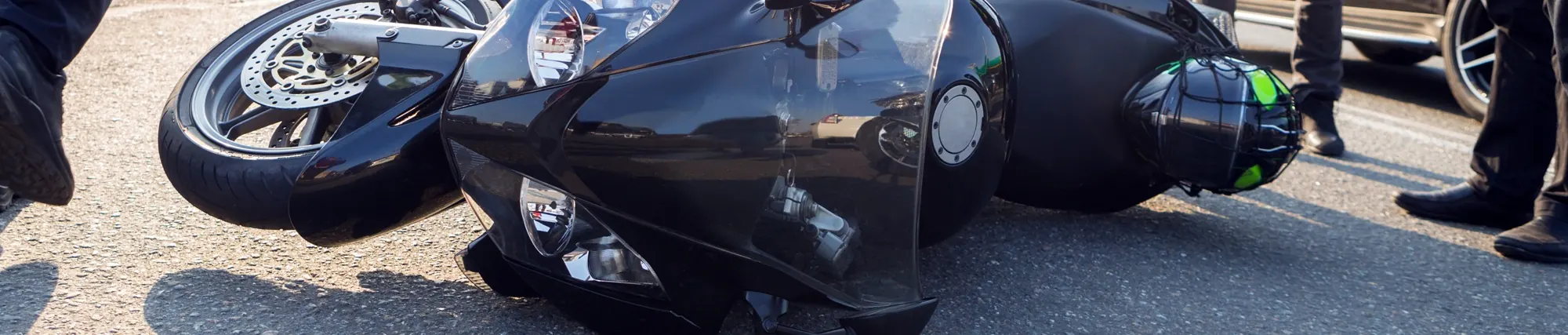

A motorcycle gives a rider very little protection in a crash. There is no frame, no seat belt and no airbag between the rider and the other vehicle or the road, so a collision that would dent a car’s fender can leave a rider with broken bones, a brain injury or worse. This guide explains what to do after a motorcycle accident in Oklahoma, why these crashes happen, the state laws that apply to riders, and how an injury claim works. It is general information, not legal advice about your case.
In this guide
- What to do after a motorcycle accident
- Mistakes that can hurt your claim
- Why motorcycle crashes are different
- Common causes of motorcycle accidents
- Oklahoma motorcycle laws that affect a claim
- Insurance and paying your medical bills
- How a motorcycle accident claim works
- What compensation may cover
- Talk to a Tulsa motorcycle accident lawyer
What to do after a motorcycle accident
The hours after a crash matter for your health and for any claim you bring later. If you are able, take these steps.
- Get to safety and call 911. Move out of traffic if you can do so without risk. Call 911 even if the crash seems minor; first responders treat injuries, and officers write the crash report.
- Get medical care right away. Some of the most serious motorcycle injuries, including internal bleeding and concussions, may not show symptoms for hours or days. Go by ambulance if you need to. Prompt care protects your health and creates a medical record that ties your injuries to the crash. Insurers often argue that a person who waited to see a doctor was not badly hurt.
- Exchange information. Get the other driver’s name, address, phone number, driver’s license number, plate number and insurance details. Oklahoma law requires drivers in a crash that causes injury or damages an occupied vehicle to stop, give this information and give reasonable help to anyone hurt.
- Photograph the scene. If it is safe, take pictures of the vehicles, their positions, skid marks, debris, the road surface, traffic signals, the weather and your injuries.
- Find witnesses. Write down names and phone numbers of anyone who saw the crash. Memories fade quickly, and witnesses can be hard to find later.
- Look for cameras. Note any businesses, homes or traffic cameras that may have recorded the crash. Footage is often erased within days unless someone asks for it to be kept.
- Keep your gear and your bike as they are. Your helmet, jacket and the motorcycle itself can show how the crash happened and how hard you were hit. Do not repair or throw away anything before it has been photographed and inspected.
- Get the police report. The report includes a diagram, the officer’s findings, any citations and witness statements. It is often one of the first documents an insurer reviews.
- Keep records. Save medical bills, repair estimates, receipts and proof of missed work. Keep a short daily note of your pain and limits.
Mistakes that can hurt your claim
- Talking about fault at the scene. Even a polite “I’m sorry” can later be described as an admission. Stick to the facts with police and leave fault to the investigation.
- Giving a recorded statement too soon. The other driver’s insurer may call within days and ask to record your account. You do not have to agree, and it is wise to speak with a lawyer first.
- Accepting a quick settlement. Early offers usually come before anyone knows the full extent of your injuries. Once you sign a release, you generally cannot ask for more, even if you later need surgery.
- Posting on social media. Photos and comments about the crash, or about your activities while you recover, can be taken out of context and used against you.
- Skipping treatment. Gaps in care give the insurer a reason to argue your injuries were minor or caused by something else.
- Waiting too long. Evidence disappears, and Oklahoma’s filing deadlines are strict. Claims involving a government agency have even shorter notice deadlines.
Why motorcycle crashes are different
Motorcycle crashes share many causes with car crashes, but the results for the rider are far more severe. According to the National Highway Traffic Safety Administration (NHTSA), 6,335 motorcyclists were killed on U.S. roads in 2023, about 15 percent of all traffic deaths, even though motorcycles make up a small share of the vehicles on the road. Per mile traveled, a motorcyclist was almost 28 times as likely to die in a crash as a passenger car occupant, and more than 82,000 riders and passengers were injured that year.
Several things set these crashes apart:
- Little protection. A car’s frame, roof, seat belts and airbags absorb much of a crash’s force. A rider takes the impact directly and is often thrown from the bike, which means a second impact with the road or another object.
- Less stability. Two wheels are less stable than four. A sudden stop, a swerve, gravel, a wet metal grate or a pothole that a car would roll over can put a rider on the ground.
- Lower visibility. A motorcycle is narrow and easy to miss, especially in a blind spot, at an intersection, at dusk or at night. Drivers also have trouble judging how fast an approaching motorcycle is moving.
- Exposure to weather and the road. Rain, wind, wet leaves, oil, bridge joints and railroad crossings are much more dangerous on a motorcycle.
- Bias against riders. Some adjusters, and some jurors, assume a rider was speeding or weaving before anyone has looked at the evidence. A careful investigation is often needed to show what really happened.
Common injuries include traumatic brain injuries and concussions, spinal cord injuries and paralysis, broken bones in the legs, pelvis, arms and collarbone, road rash that may need skin grafts, internal bleeding, facial and dental injuries, amputations and lasting emotional trauma. Our article on common motorcycle accident injuries covers these in more detail.
Common causes of motorcycle accidents
Most motorcycle crashes involving another vehicle come down to a driver who did not see the rider, misjudged the rider’s speed or simply was not paying attention. The most common causes include:
- Left turns in front of a rider. This is the classic motorcycle crash. In 2023, in 46 percent of fatal crashes between a motorcycle and one other vehicle, the other vehicle was turning left while the motorcycle was going straight, passing or overtaking. The driver often says, “I never saw them.”
- Failure to yield and intersection crashes. Drivers pull out from side streets, parking lots and driveways, run red lights or roll through stop signs. Intersections, with turning traffic and crossing paths, are where many serious motorcycle crashes happen.
- Unsafe lane changes. A motorcycle fits easily into a car’s or truck’s blind spot. A driver who changes lanes without checking mirrors and turning to look can push a rider off the road.
- Rear-end collisions. A light tap that would be a fender bender between two cars can throw a rider over the handlebars. A motorcycle can stop faster than many cars, so tailgating is especially dangerous. In Oklahoma, the following driver is generally expected to keep a safe distance.
- Speeding. Speed shortens reaction time and makes every impact worse. NHTSA reports that 36 percent of motorcycle riders involved in fatal crashes in 2023 were speeding; when another driver is the one speeding, the rider has even less time to react.
- Distracted and drowsy driving. A driver looking at a phone, a navigation screen or a passenger is far less likely to notice a motorcycle. Fatigue has a similar effect, especially at night.
- Impaired driving. Alcohol and drugs slow reaction time and impair judgment. Impaired drivers are a particular danger to riders at night.
- Dooring. A parked driver or passenger who opens a door into traffic without looking can leave a rider no time to stop.
- Road hazards. Potholes, crumbling pavement, gravel, debris, missing signs and poor lane markings are far more dangerous on two wheels. When a road defect causes a crash, a city, county, state agency or private contractor may be responsible. See our article on liability for pothole accidents in Oklahoma.
- Hit-and-run drivers. Some drivers flee because they are uninsured, impaired or driving on a suspended license. Leaving the scene of a crash that causes injury is a crime in Oklahoma. Police may still find the driver through witnesses, video or vehicle damage, and your own uninsured motorist coverage may help if they do not.
Time of day matters too. NHTSA data show that 39 percent of motorcyclist deaths in 2023 happened in the dark, and riding in evening rush hour and after dusk carries extra risk. Our article on why riding at night is especially dangerous explains why.
Oklahoma motorcycle laws that affect a claim
Helmets and eye protection
Oklahoma does not require adult riders to wear a helmet. Under 47 O.S. § 12-609, anyone under 18, whether driving or riding as a passenger, must wear a helmet that meets federal safety standards. The operator of a motorcycle without a windshield must wear goggles or other protective eyewear.
Helmets save lives. NHTSA estimates that a helmet reduces the risk of death in a crash by about 37 percent for riders and 41 percent for passengers, and riders without helmets are far more likely to suffer a traumatic brain injury. Modern helmets meeting federal standards still allow a wide field of view, and sounds loud enough to hear over wind and engine noise can still be heard inside a helmet.
Not wearing a helmet as an adult is legal, and it does not cause a crash. Even so, an insurer may argue that some of a rider’s head injuries would have been less severe with a helmet and try to reduce the claim on that basis. How much weight that argument carries depends on the facts, which is one reason to have a lawyer review the case. The same goes for other gear: a heavy jacket and pants, gloves and boots help prevent road rash and other injuries.
Lane splitting
Lane splitting, riding between lanes of traffic moving in the same direction, is not legal in Oklahoma. Under 47 O.S. § 11-1103, a motorcycle may not pass other vehicles between lanes of traffic traveling in the same direction. If a rider was lane splitting at the time of a crash, the insurer will likely argue that the rider shares the blame. That does not end the claim, but it can reduce it. Many crashes that are first blamed on “aggressive riding” turn out, after investigation, to have been caused mainly by a driver’s failure to yield or sudden lane change.
Comparative fault
Oklahoma uses a modified comparative negligence rule (23 O.S. § 13). A rider who is partly at fault can still recover, as long as the rider’s share of fault is not greater than the combined fault of the others responsible. The award is reduced by the rider’s share. For example, if a rider’s damages total $100,000 and the rider is found 20 percent at fault, the rider may recover $80,000. A rider found more at fault than everyone else combined recovers nothing. Because every percentage point affects the outcome, insurers often look for ways to shift blame to the rider.
Insurance and paying your medical bills
Medical bills after a motorcycle crash can be very large, and they often arrive before any claim is resolved. Several kinds of insurance may help.
- The at-fault driver’s liability coverage. Oklahoma is an at-fault state, so the driver who caused the crash, and that driver’s insurer, are responsible for your losses. Oklahoma’s minimum liability limits are $25,000 per person and $50,000 per accident for bodily injury, and $25,000 for property damage. Those minimums are often far below the cost of a serious motorcycle injury.
- Your own uninsured and underinsured motorist (UM/UIM) coverage. If the at-fault driver has no insurance, too little insurance or cannot be identified after a hit-and-run, UM/UIM coverage on your own policy may cover the gap. Many people do not realize they have it until a lawyer reviews the policy.
- Medical payments (MedPay) coverage. MedPay pays medical bills up to the policy limit regardless of who was at fault, which can help while the main claim is pending.
- Health insurance. Health insurance may pay for treatment in the meantime. It may later ask to be repaid from a settlement, and those repayment claims can often be negotiated.
An insurer will only pay up to its policy limits. When the injuries are serious, finding every available source of coverage, and every party who may share responsibility, can make a large difference in what you recover.
How a motorcycle accident claim works
Most claims start with a demand to the at-fault driver’s insurance company. To succeed, you must show that someone else was negligent, that the negligence caused the crash, and what your injuries and losses are. Evidence usually includes the police report, photographs, witness statements, video, damage to the vehicles and gear, and your medical records. In serious cases, an accident reconstruction expert may analyze the scene.
Many claims settle through negotiation. If the insurer will not make a fair offer, the next step is a lawsuit. Simple cases with clear fault can settle within months; cases with disputed fault or catastrophic injuries can take a year or more, especially if a lawsuit is filed. It is usually best not to settle until your doctors have a clear picture of your future care.
Deadlines
In Oklahoma, most personal injury lawsuits must be filed within two years of the injury (12 O.S. § 95). If you miss the deadline, you may lose the right to recover anything. Claims against a government entity, such as a city or the state over a dangerous road, are governed by the Governmental Tort Claims Act, which requires a written notice of claim within one year and has its own short deadlines after that. Other exceptions can apply, for example when the injured person is a minor, so it is best to get advice early.
When a rider is killed
When a motorcycle crash is fatal, certain family members may bring a wrongful death claim against the people responsible. These claims can seek medical and funeral expenses, the financial support the person would have provided, the pain the person suffered before death, and the grief and loss of companionship suffered by the family.
What compensation may cover
Depending on the facts, an injured rider may be able to recover:
- Medical expenses, including emergency care, hospital stays, surgery, rehabilitation and future treatment
- Lost wages and benefits while you recover
- Loss of future earning capacity if you cannot return to your job
- Repair or replacement of your motorcycle and riding gear
- Pain and suffering and emotional distress
- Permanent disability, scarring and disfigurement
- Loss of consortium for a spouse
Injuries such as a traumatic brain injury or a spinal cord injury can affect a person for life, so a fair recovery must account for future medical needs, home changes and lost earning ability, not just the bills already paid. In cases of especially reckless conduct, such as driving while heavily intoxicated, Oklahoma law may also allow punitive damages.
Talk to a Tulsa motorcycle accident lawyer
If you or a loved one was hurt in a motorcycle crash in Tulsa or anywhere in northeastern Oklahoma, the motorcycle accident lawyers at Levinson Law, P.C. can review what happened, deal with the insurance companies and work to hold the responsible people accountable. If your injuries keep you from coming to our office, we can come to you. Call 918-492-4433 or contact us online to set up a free consultation.